Publisher’s note
This book “I am
That Very Being” is the autobiography of the
late Fatima Zahra Qazi Sahiba, an exemplary
woman of Diplo city. In it, she has written
about her family and the story of her life in a
very beautiful way.
The Sindhi Adabi Board is rightly proud that
many important and useful books on every subject
of Sindhi literature have been published by this
institution. Especially in the field of
autobiography, biographies of positive
personalities of Sindh have been published which
encloses the name of rare and famous scholars
Shamsul Ulama Mirza Qaleech Baig’s book “Sao Pan
Ya Karo Pano”, Syed Husamuddin Rashdi’s book
“Hoo Dothi Hoo Deenhan”, Sain G. M. Syed’s book
“Jinab Guzariam Jin Seen” and Pir Ali Muhammad
Rashdi’s book “Uhee Deenhan Uhee Sheen” are at
the forefront and now this book “I
am That Very Being”
is also of informative importance in the field
of autobiography.
Sindhi Adabi Board has been striving since the
beginning to publish and bring to the fore such
scholarly and literary treasures of Sindh. At
present, under the special interest of the
Board’s Honorable Chairman, Makhdoom
Saeed-uz-Zaman ‘Atif’, new books are being
published by the Sindhi Adabi Board. Due to his
affiliation with the scholarly and literary
community, the Board has developed innovative
programs to promote the publication of new books
on a priority basis in consultation with the
members of the Board’s Publication Committee. In
addition, a publication scheme of fifty
magazines has also been started under his
guidance, and especially to publish on a
priority basis the literary works of such
writers and poets of Sindh, whose literary works
have not come to the fore before.
I am profound to
publish the first edition of this book “I am
That Very Being” by the Sindhi Adabi Board under
the patronage of the Board’s Honorable Chairman,
Makhdoom Saeed-uz-Zaman ‘Atif’.
It is expected to invite our writers, scholars,
literary friends and readers to pay their
attention to work on the autobiography,
biographies of the important personalities,
Sindhi literature and Lok Adab etc.
13 Ramadan, 1447 AH
Mirza Dabeer Hussain Baig
Secretary
03 March, 2026
Dust from Ami's feet
The name
'Mother' itself is sweet. So sweet that even the
sweetness of honey is insignificant before it.
Allah Ta'ala [God Almighty] has created humans
endowing them with various qualities. Every
person's behaviour towards another person is
different: sweet for some, bitter for others! We
hold the same impression about any person as our
feeling is about their behaviour. The female
being, obviously, is not exempt from this
arrangement of nature. For her too, one person
will hold one opinion, while another person will
hold another. But behold the glory of nature,
that every child holds one and the same
impression about their mother: "There is no one
like my mother!" Amazing! It seems that when a
woman takes the form of a mother, all other
contradictory aspects of her personality as an
ordinary human being become suspended, and she
remains just "Mother," who is a wholesome
compassion - who is an entire sacrifice - who
is prayer, just prayer - who is the breeze of
paradise and who, in the cold and heat of the
world, is a sheltering shade!
About my own
mother [Ami], it's obvious that I too will say,
"There is no mother like my mother!" But merely
out of this apprehension that someone might mock
me, "What new thing has he said?" I cannot shy
away from expressing my impression about my
mother. The truth is, just as fragrance cannot
be separated from a flower, and just as
sweetness cannot be separated from honey,
similarly, Ami's love cannot be separated from
my heart! Ami is a part of my existence; she is
my soul. If Ami is, then I am too, otherwise,
that's it!! In the words of Ustad Bukhari, "Yes,
without you, I am nothing at all."
Ami has always
told us everything about her life, time and
again. An eighteen-year-old pampered girl,
raised in the boundless affection and love of
her father and mother, when she comes to the
house of a thirty seven year old seasoned man,
such a change immediately occurs in her
behaviour and personality that she becomes a
responsible woman. See, on one hand, the
father's advice: "Ama [My dear girl], this
Pado [a kind of traditional skirt of
Thari women] is the symbol of my 'Hoor'
[Elder sister of Fatima Zahra, the author]. You
may not wear it if you do not like, but don't
sell it either!" And on the other hand, upon
Bua [paternal aunt - used here as an
honorific for an elderly woman] Halima's mere
casual expression [of liking it], that very
Pado, along with the Gaj [embroidered
shirt front] and Chuni [scarf], presented
to Bua! Is there any other person who is so
pure-natured; so discerning of matters; so
largehearted? Then how could our Baba Sain
[father] not be exceedingly appreciative of Ami?
Baba himself was also a magnificent masterpiece
of Allah Ta'ala's [God, the Exalted] glorious
creation. But remember! In this exemplary
relationship of love and appreciation, the
beginning of self-forgetfulness and
self-sacrifice was made by Ami!
Perhaps Allah
Ta'ala was preparing Ami for the stages to come
in her future life. Indeed, that was it. Then, a
series of trials began. Daughters upon daughters
born in a family longing a lifetime for a son.
Some are born, only to depart in infancy; two
sons, consecutively, one after the other, come
into her lap and then leave, inflicting the
wounds of separation. The neighbours' talk –
like salt on fresh wounds! Some trials are
indeed like trials! Yet, there was patience;
yet, restraint; yet, courage; yet, hope in
Allah.
We had heard
these tales, but when our children also heard
them, they too were immensely affected, and I
understand that these stories played a very
significant role in the building of their
personalities and character.
Today, this book
written by Ami is in your hands. The truth is
that I did not decide to publish this book to
praise Ami or to display my own filial piety,
but rather, I sincerely believe that the events
of Ami's life, Ami's impressions, Ami's
restraint and courage in trials, and living the
life constructively in all circumstances – all
these things can serve as a 'guiding light' for
our young generation as well as readers.
When Ami had
intended to write this book, she first confided
in me. At that time, I had thought that indeed,
this priceless treasure of wisdom and knowledge
should be preserved for us. Then Ami would
sometimes read excerpts and incidents from it to
me. I used to encourage Ami. Sometimes she would
recount some events to my sisters and brother
Mashhood over the phone or in person. Everyone
felt passionately that Ami must write. It would
be our treasure. But Ami's true confidant and
companion was my son Farhan, who used to stay in
Ami's room. Before sleeping at night, Ami would
read to him the pieces she had written during
the day. After listening, Farhan would say,
"Very good, Ami Jan [Dear Ami]! Then what
happened?" The fact that Farhan’s extraordinary
place in the family today is due in large part
to Ami's upbringing.
Anyway, I was
talking about Ami's book. Initially, the thought
was that this would be a small 'memoir', but
when I read it systematically, I couldn't hold
back tears at many places. When I read several
previously heard incidents, it felt as if
everything was happening right before my eyes.
Such was the impact of Ami's writing. Realism,
depth of emotions, maturity of thoughts, a
heart-touching style brimming with truthfulness!
I felt that this treasure should not just remain
in the form of a diary but should be the
foundation for all of us - brothers and sisters.
At that time, Shahid Memon, who used to be in
Khairpur, I asked him to get it composed on the
computer. After dinner, sitting on the bed in
Ami's room, we would chat and also edit the
book. It was the work of many nights, but time
just seemed to fly by. We created the title and
headings. In everything, we two were
like-minded. Eleven copies were made and ready.
Sisters and brothers divided and took them.
Six years passed
just like that. My sister Aziz, especially
cherished this book with her heart and soul. She
read it time and again and was so influenced by
it that she herself started writing. Other
sisters, as well as brother Mashhood, made this
book a part of their lives.
On January 5,
2014, when Baba Sain's book "Safar Zindagi-a Jo"
[Journey of Life] was launched, the chief guest
of that program was our respected honorable
Mehtab Akbar Rashdi Sahiba. At that time, on the
stage, Ami gave her the book. Seeing Ami's book,
Madam gave me the order, "Shahid! Your next
assignment is to get Ama's book published." I
respectfully agreed.
Today, with
great affection, Madam Sahiba, in the 'Preface'
of the book, has written about Ami and our
family. The points she has elucidated from
studying the book – the pen is incapable of
describing them. The truth is, the enthusiasm
with which Madam has participated in the
publication of this book and the wonderful
advice she has given are beyond count. May Allah
Pak [Holy God] grant her reward for it.
Our dear
brother, Dr. Aftab Abro Sahib, like with Baba
Sain's book, girded his loins to publish this
book as well. The fruit of his day-and-night
efforts and boundless endeavors came up in the
shape of the first edition of this book. I am
heartily thankful to Dr. Aftab Abro Sahib. May
Allah Ta'ala keep him in His protection and may
no adversity ever befall him.
I am certain
that after reading this book, your heart will
surely be impressed that living a life with
purpose is also a commendable approach, and I
will take it as if the instruction of our
respected sister, honorable Mehtab Akbar Rashdi
Sahiba, regarding publishing this book, the
relentless efforts of my nephew Raza Mohammad
Qazi and my humble efforts of editing, proof
reading and finding the best possible diction of
Ami’s writing and Shah Abdul Latif Bhittai’s
poetic translation have received your approval.
If you wish to
offer any advice regarding this book, please
suggest it to me. Your suggestion will be given
full attention in the next edition.
On the fateful
day of 13th September, 2021 Ami - our beloved
mother - our solace of heart - left us in this
world alone in the wilderness. Soon after Ami’s
passing away, when the grief of Ami’s passing
was still an open wound, there came a breeze of
solace, a healer of broken hearts - Makhdoom
Jameel-uz-Zaman Jameel Sahib for condolence. He
himself a shining star of art and literature -
the former chairman of Sindhi Adabi Board,
offered to publish Ami’s book under the aegis of
Sindhi Adabi Board. His most able brother,
himself a great Literary figure of our times,
Makhdoom Saeed-uz-Zaman “Atif”, the present
Chairman of Sindhi Adabi Board, most fondly took
up the assignment. The second edition in Sindhi
Adabi Board was published within a week’s time.
Today, this
English transliteration is in your hands.
Makhdoom Saeed-uz-Zaman “Atif” Sahib has very
kindly offered to publish it especially for
those audience who cannot read Sindhi but would
be interested to know of the life of a Sindh’s
un-wavering woman as Madam Mehtab Akbar has
rightly called her.
Dust from Ami's
feet,
Qazi Shahid
Pervez
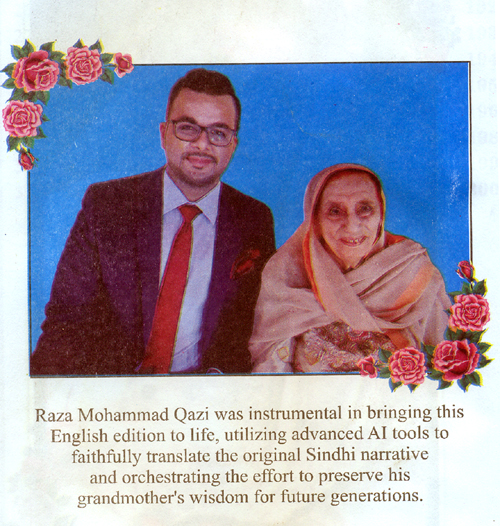
Unveiling a Legacy: Translating Fatima Zahra
Qazi's "Aaoon Je Ihāee Zāt" for
Generations to Come
Unveiling a Legacy: Translating Fatima Zahra
Qazi's "Aaoon Je Ihāee Zāt" for Generations to
Come The seed for this project was planted in a
simple phone conversation in January 2025.
Chatting with my uncle, Qazi Shahid Pervez, the
topic naturally turned to my grandmother, Fatima
Zahra Qazi, and the extraordinary life she had
chronicled in her memoir, "Aaoon Ihāee Zāt" – "I
Am That Very Being". This book wasn't just a
collection of memories; it was a profound
testament to her resilience, her deep faith, and
the rich tapestry of her experiences. Yet, for
me, a Canadian by upbringing, a significant
language barrier made its deepest truths feel
just out of reach. Though I speak Sindhi and am
connected to my culture, the unique literary
style of my grandmother's writing – the
intricate Sindhi, the poetic flourishes, the
philosophical insights she wove into her
narrative – was a challenge. She had poured her
heart into this memoir, not just to tell her
story, but to explain her background, the
cultural milieu of Sindh, Pakistan, in which our
family and ancestors lived, and to impart her
wisdom to her children and, by extension, to us,
her grandchildren. Even with my cousin Farhan
Shahid Qazi’s commendable effort to have her
narrate the book for a YouTube series, the
nuances often eluded me. I knew that the full
depth of her message, the details of her
journey, her trials, her marital experiences,
her innermost feelings, and the cultural context
she so vividly painted, weren't fully accessible
to me as a predominantly English speaker. Chacha
Shahid, who, along with my father, Mashhood
Ahmed Qazi had invested so much love and effort
into publishing their mother's memoir, mentioned
how valuable an English translation would be.
This struck a chord. If I, with some familiarity
with Sindhi, found it difficult to fully absorb
the gravitas of her words, what would it mean
for future generations? My own daughter (Fatima
Zahra Qazi), named in honor and fond memory of
her great-grandmother, understandably never had
the chance to meet her. How could this vital
piece of our heritage, this precious window into
the soul and wisdom of Fatima Zahra Qazi, be
preserved and shared? This realization sparked a
deep sense of purpose. I suggested to Chacha
Shahid, perhaps with more determination than
foresight at the time, that we explore using
large language models to create a faithful
English translation. I felt a strong conviction
that I needed to find a way. The challenge was
significant. Chacha recounted how he had once
given the memoir to a specialist writer, an
expert in Sindhi, Urdu and English literary
translation. Yet, even this seasoned
professional, after two months, acknowledged
that the unique literary quality and profound
depth of my grandmother's Sindhi made a truly
faithful translation exceptionally difficult.
Far from being discouraged, this fueled my
resolve. Here was a vital piece of our family's
history, a chronicle of a remarkable woman's
life, obscured by language. The desire to unlock
it, to share her voice and wisdom, became a
compelling mission. The practicalities were
daunting. The only available copy of the final
book was a PDF where a non-standard Sindhi font
had been used. This meant that to a computer,
much of the text was a jumble of unreadable
characters or odd codes, with English numerals
and words often appearing reversed. The first
step was to meticulously work through this
"corruption," a painstaking process of trying to
decipher the intended Sindhi before any
translation could even begin. My initial
attempts at prompting AI were, admittedly, quite
basic. But as I shared early translated segments
with Chacha Shahid and Baba Saeen, their
feedback was invaluable. Listening to them
discuss the nuances of a particular phrase,
whether it truly captured their mother's unique
voice and the emotions she conveyed, was a
profound learning experience. They dedicated
countless hours to reviewing these drafts, their
encouragement bolstering my own motivation to
connect more deeply with my grandmother's life
story, her philosophy, and our shared heritage.
It became clear that a far more sophisticated
approach to the AI prompting was needed. I
needed to guide the AI with a deep understanding
of my grandmother's emotional landscape as she
penned her words, to ensure the translation
captured not just the literal meaning, but the
cultural subtleties, the unspoken sentiments,
and the poetic heart of her narrative. My
prompting strategy evolved significantly,
becoming a detailed system that instructed the
AI on handling metaphors, specific cultural
terms (we developed a running list of previously
explained terms to maintain consistency and
flow), formatting poetic verses, and, most
importantly, to derive its understanding solely
from the corrected, but still imperfect, Sindhi
text. The process was intensive, spanning four
months of dedicated effort – long nights, early
mornings, and a relentless focus. Each
successfully translated passage felt like a step
closer to truly hearing my grandmother. It was a
collaborative effort, a blend of technology and
the deep, personal understanding of her sons,
who knew her voice and her heart. Now, I hold a
draft that I believe is a very close
approximation of what my grandmother would have
written had she penned her memoir in English.
It's a translation that I hope captures not just
the events of her life, but the spirit that
animated it. Within these pages, readers will
discover the vivid tapestry of a life lived with
profound faith and resilience in early to
late-20th century and early 21st
century Sindh, Pakistan. They'll journey with
Fatima Zahra Qazi through her cherished
childhood in Diplo, her pursuit of education
against the odds, the complexities and joys of
her marriage, and the heart-wrenching trials of
motherhood, particularly her experiences with
infant loss – a sorrow she bore with incredible
strength. The memoir also illuminates her
unwavering support for her husband and children,
her dedication to community upliftment, and her
deeply insightful reflections on life, faith,
and the enduring strength of family bonds. She
shares not just her personal history, but the
cultural values, the societal norms, and the
deep-rooted philosophies that shaped her world
and our family's heritage. What began as a
personal quest to connect with my grandmother's
story has, I hope, culminated in something more:
a historical artifact, a window into a specific
time and the extraordinary journey of an
ordinary, yet extraordinary, woman. My deepest
wish is that this translation resonates with
readers as profoundly as the journey of its
creation has resonated with me. I hope it allows
others to connect with the wisdom, the sorrows,
and the triumphs of a life so richly lived. My
only regret is that I can't tell my grandmother
I finally get it, I really understand what she
poured into those pages. In translating her
work, I hope I have honored her, respected her
voice, and, in my own small way, helped to
ensure that her essence, her "Aaoon Je Ihāee Zāt,"
continues to inspire and enlighten for
generations to come
Raza Mohammad Qazi
|